Written by Dr. Karen Férez & Omar Sharife
When Representation Becomes a Filter
A few years ago, a social media filter that simulated vitiligo went viral. It allowed anyone to “try on” the condition for a few seconds and then remove it instantly with a swipe. For many users it was just another filter, another novelty in a digital world full of trends. But for those living with vitiligo, it was something entirely different.
For people living with vitiligo, those spots are not a filter,” reflects Dr. Karen Férez,
Karen Férez
dermatologist and President of the Mexican Foundation for Vitiligo. “They are real, permanent, and deeply personal. They carry years of misunderstanding, questions, curiosity, and sometimes discrimination.
Representation Without Empathy
That moment, she explains, became a turning point. It revealed a problem that is now resurfacing on a much larger scale with artificial intelligence: representation without empathy. When images are created without understanding, without lived experience, and without accuracy, they can
unintentionally cross the line from awareness into appropriation.
Today, with AI tools spreading faster than any previous technology, the issue has grown exponentially. AI-generated images of vitiligo are being shared widely, sometimes as art, sometimes as “representation,” sometimes as decoration. But what happens when a machine, not a person, becomes the face of a community?
A Community Perspective on AI-Generated Images
Omar, President of Vitiligo Voices Canada, brings the community’s emotional perspective to this question.
I used AI-generated images myself at first,” he admits. “It felt creative. It felt fast. It felt like a shortcut to representation when I didn’t have photos available. But the more I grew in this space, the more I saw the harm it could cause.
Omar Sharife
For Omar, the harm is not abstract. It is woven into the lived reality of the people he works with every day.
Vitiligo is already full of misunderstanding and social pressure. Many of us work incredibly
Omar Sharife
hard to show up authentically in public spaces. So when AI fabricates people who ‘have’ vitiligo, we’re not increasing representation. We’re diluting reality.
Clinical Accuracy and the Risk of Misinformation
Karen adds that beyond the emotional impact, there are serious clinical concerns
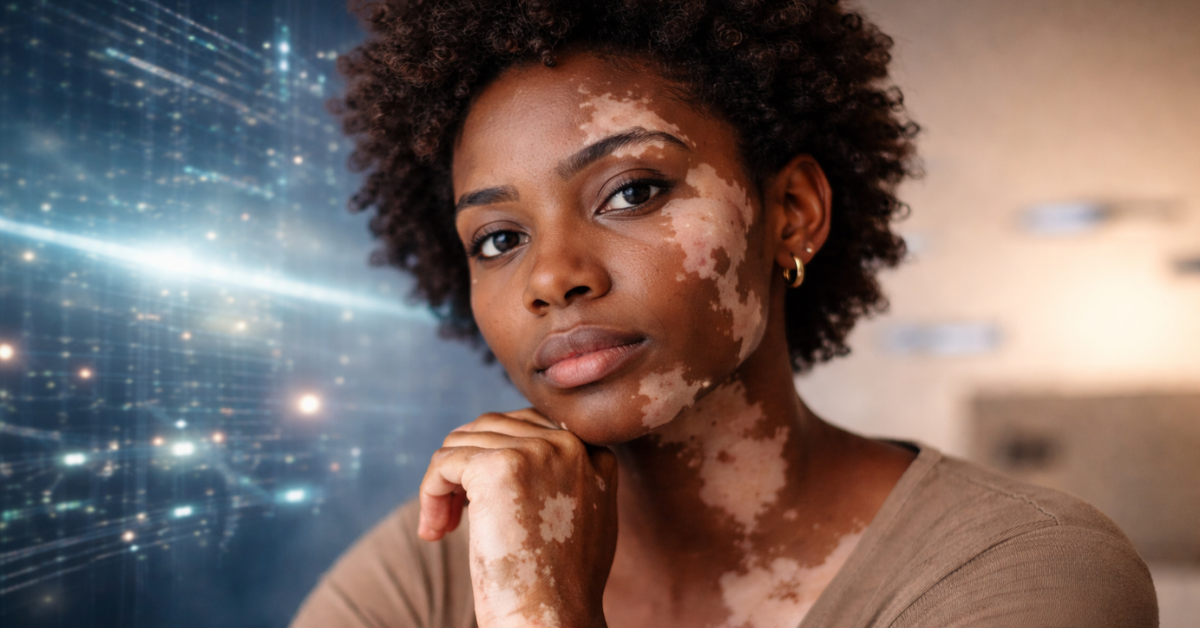
Most AI-generated depictions of vitiligo are simply inaccurate, she explains. Patches appear in random shapes and locations, without respecting the true distribution or morphology of the condition. The textures are often wrong, the borders incorrect, the patterns impossible. Instead of educating, these images may teach the public the wrong things
Karen Férez
This, she notes, is particularly dangerous at a time when misinformation spreads faster than qualified medical information. AI-generated inaccuracies, even if unintentional, can reinforce myths, distort expectations, and create unrealistic or misleading portrayals of the disease.
Vitiligo is not an aesthetic effect, she insists. It’s part of someone’s identity. It deserves accuracy, context, and humanity.
Karen Férez
AI Cannot Carry Lived Experience
Omar agrees and expands the reflection.
AI can copy the pattern, but it cannot carry the story,” he says. “It cannot show the courage it takes for someone to embrace their skin. It cannot portray the stares, the questions, the medical journeys, or the emotional resilience behind each patch. It cannot stand in for us.
Omar Sharife
He then asks a question that many avoid. Would any other community accept synthetic representation?
We wouldn’t create AI burn survivors to raise awareness. We wouldn’t generate artificial
Omar Sharife
images of people with facial differences or limb loss. People would immediately call it
disrespectful and dehumanizing. The same standard must apply to vitiligo.
Representation Rooted in Reality
This shared understanding leads both leaders to the same conclusion. Representation must be rooted in reality, not artificial replication. Awareness must center real people, real bodies, and real stories, not imagined versions created for convenience or aesthetics.
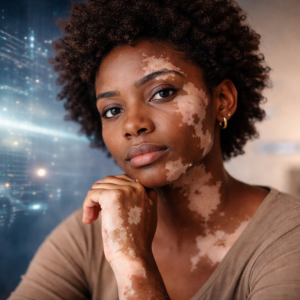
This image is AI-Generated
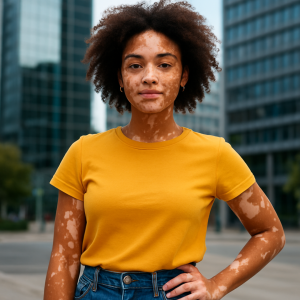
This image is AI-Generated
A Responsible and Ethical Role for Technology
At the same time, Karen and Omar are not advocating for the rejection of technology. Instead, they call for a responsible and ethical approach that acknowledges both the potential and the limitations of AI.
Artificial intelligence can be a valuable tool when used to support, not replace, human narratives. AI can assist with educational graphics, research, visualizing dermatological mechanisms, or abstract brand and design assets. However, it should not be used to invent human beings with a condition they do not have.
They also stress that transparency is essential. If an AI-generated model or image is used in any context, it must be clearly identified as artificial. Viewers should never be left to assume that a synthetic image represents a real person or lived experience. Disclosure is not optional. It is a responsibility.
Advocacy Must Remain Human
Omar summarizes this with clarity.
Good intentions aren’t enough. We need to decide what kind of advocacy we stand for. And for me, AI-generated vitiligo models shouldn’t be part of raising awareness. Advocacy must uplift the people who already exist.
Omar Sharife
Karen echoes the sentiment.
Our community doesn’t need to be imagined. Our skin doesn’t need to be recreated. The real
stories are powerful enough.
At the heart of their message lies a shared belief. Technology should amplify human dignity, not fabricate it. Vitiligo advocacy, they agree, must remain human at its core.